
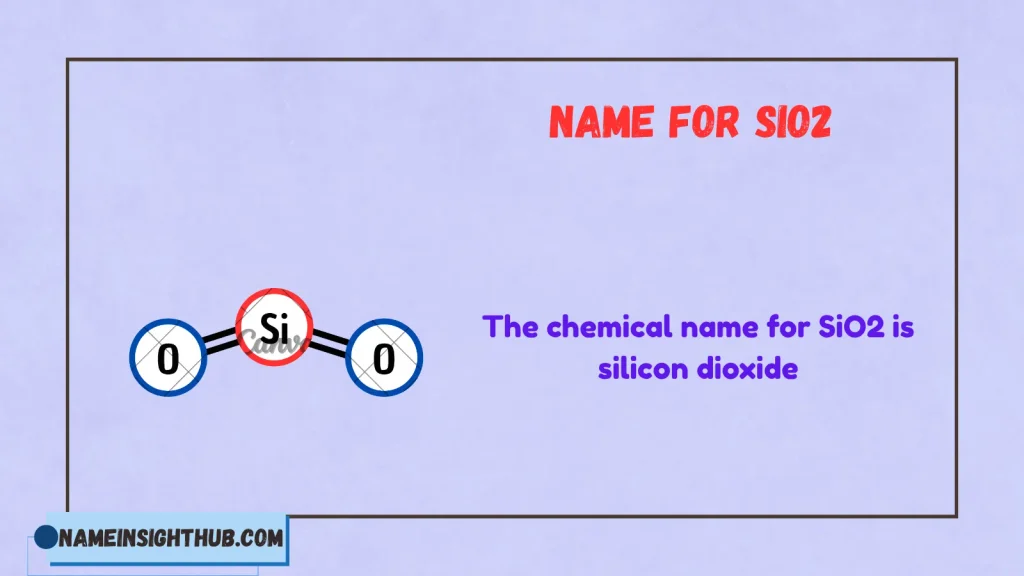
If you are searching for the name for SiO2, the answer is silicon dioxide. It is a chemical compound made of silicon and oxygen. You may also recognize it as silica, quartz, or the main component of ordinary sand.
Although these names are closely related, they do not always mean exactly the same thing in every scientific context.
Silicon dioxide is found in rocks, minerals, soil, sand, and many natural materials. It also has important uses in glassmaking, construction, electronics, and food production.
What Is the Chemical Name for SiO2?
The chemical name for SiO2 is silicon dioxide. It is an inorganic compound formed when one silicon atom combines with two oxygen atoms.
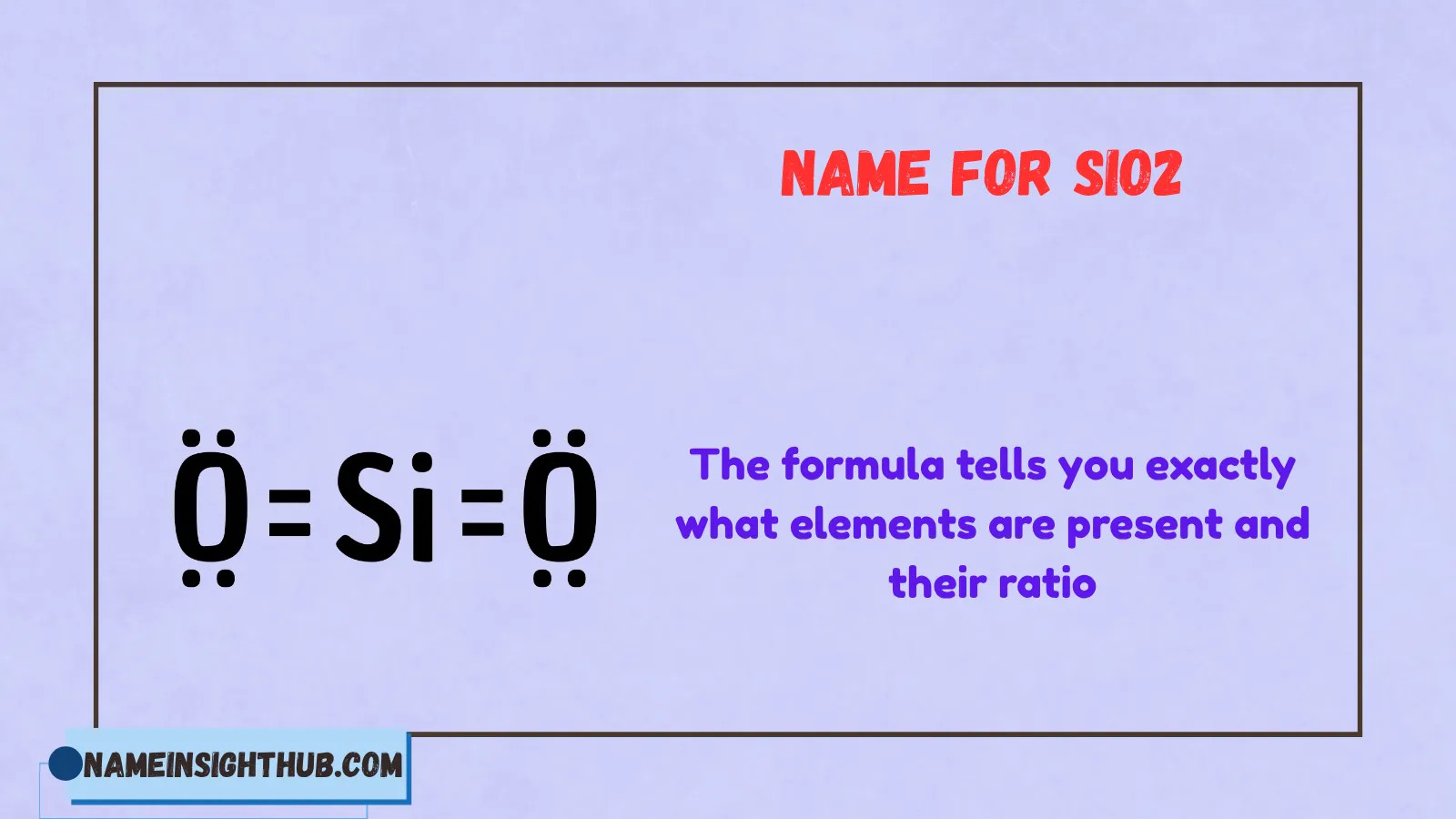
The formula tells you exactly what elements are present and their ratio. The symbol Si represents silicon, while O represents oxygen. The small number 2 means there are two oxygen atoms for every silicon atom in the formula.
Silicon dioxide is one of the most common compounds found in Earth’s crust. It occurs naturally in many minerals, especially quartz.
Here are the basic details:
- Chemical name: Silicon dioxide
- Chemical formula: SiO2
- Common name: Silica
- Molecular composition: One silicon atom and two oxygen atoms per formula unit
- Molar mass: Approximately 60.08 g/mol
- Compound type: Inorganic compound
- Main elements: Silicon and oxygen
- Appearance: Usually a white or colorless solid in purified forms
- Natural occurrence: Sand, quartz, rocks, and several other minerals
The name silicon dioxide is used in chemistry because it clearly describes the two elements that make up the compound.
15 Common and Alternative Names for SiO2
Silicon dioxide is known by several names in science, industry, and everyday language. Some refer to the chemical compound itself, while others describe a particular natural form or commercial type.
Here are 15 useful names and related terms.
- Silicon dioxide: The standard chemical name used in science and chemistry.
- Silica: The most widely used common name for SiO2.
- Quartz: A crystalline mineral made of silicon dioxide.
- Silica dioxide: An occasionally encountered descriptive variation, although silicon dioxide is the correct standard chemical name.
- Crystalline silica: A term for silicon dioxide with an ordered crystal structure.
- Amorphous silica: A noncrystalline form without long-range crystal order.
- Fused silica: High-purity silica produced by melting silicon dioxide.
- Vitreous silica: Another name for glass-like, noncrystalline silica.
- Silica glass: A glass material made primarily from silicon dioxide.
- Silica sand: Sand containing a high proportion of silica, commonly quartz.
- Rock crystal: A clear, colorless variety of quartz.
- Flint: A fine-grained form of silica-rich rock, commonly containing microcrystalline quartz.
- Chert: A hard sedimentary rock composed mainly of microcrystalline silica.
- Diatomaceous earth: A naturally occurring material formed largely from the silica-rich remains of diatoms.
- Silicon(IV) oxide: A systematic name that indicates silicon’s oxidation state.
Important: These terms are related, but they are not all exact synonyms. For example, quartz is a specific crystalline mineral, while silica can describe a much wider range of silicon dioxide materials.
Different Types of Silicon Dioxide
Silicon dioxide occurs in several forms. The main difference between these forms is how their atoms are arranged.
Understanding these types helps explain why the same chemical formula can describe materials with different physical properties.
Crystalline Silicon Dioxide
Crystalline silica has an organized structure in which silicon and oxygen atoms form a repeating pattern. Quartz is the most familiar example.
Other crystalline forms include:
- Quartz: The most common crystalline form of silica.
- Cristobalite: A high-temperature crystalline form that can also occur naturally.
- Tridymite: Another crystalline form associated with high-temperature conditions.
- Coesite: A dense form that can develop under very high pressure.
- Stishovite: A particularly dense form associated with extreme pressure.
- Moganite: A less common crystalline silica mineral.
- Keatite: A relatively uncommon synthetic crystalline form.
- Chalcedony: A microcrystalline to cryptocrystalline form of silica.
- Agate: A banded variety of chalcedony.
- Onyx: A banded form of chalcedony, often with contrasting colors.
These forms share the same basic chemical composition, but their crystal structures differ.
Amorphous Silicon Dioxide
Amorphous silica does not have the long-range repeating crystal pattern found in quartz. Its atomic arrangement is more disordered.
Common examples include:
- Silica gel: A porous material used to absorb moisture.
- Fumed silica: A fine synthetic powder used in coatings, adhesives, and other products.
- Precipitated silica: A manufactured form used in rubber, toothpaste, and industrial materials.
- Silica glass: A glass-like form used in specialized optical and scientific equipment.
- Diatomaceous silica: Silica associated with the remains of microscopic aquatic organisms.
- Colloidal silica: Tiny silica particles dispersed in a liquid.
- Biogenic silica: Silica produced or accumulated by living organisms.
Amorphous silica has many commercial uses, but its properties depend on how it is produced and processed.
## Chemical Formula and Molecular Structure of SiO2
The chemical formula of silicon dioxide is SiO2. It shows a 1:2 ratio of silicon to oxygen.
However, its structure is more interesting than the formula may suggest. In common crystalline forms such as quartz, silicon dioxide does not exist as separate, simple SiO2 molecules. Instead, its atoms form a large three-dimensional network.
Each silicon atom is bonded to four oxygen atoms in a tetrahedral arrangement. These oxygen atoms connect neighboring silicon atoms, creating a strong network.
What Does Each Part of the Formula Mean?
- Si: The chemical symbol for silicon.
- O: The chemical symbol for oxygen.
- 2: Two oxygen atoms for every silicon atom.
- SiO2: The overall chemical formula showing the ratio of these elements.
The formula is also known as an empirical formula because it gives the simplest whole-number ratio of the elements.
What Is the Molar Mass of Silicon Dioxide?
The molar mass of SiO2 is approximately 60.08 grams per mole.
You can calculate it using the atomic masses of silicon and oxygen:
| Element | Number of atoms | Atomic mass | Total |
|---|---|---|---|
| Silicon (Si) | 1 | 28.09 | 28.09 |
| Oxygen (O) | 2 | 16.00 | 32.00 |
| Total | 3 | 60.09 g/mol |
Small differences in the final value come from rounding atomic masses.
Physical and Chemical Properties of Silicon Dioxide
Silicon dioxide has several properties that make it useful in natural environments and industrial products. Its hardness, heat resistance, and chemical stability are among its most important features.
Here are 15 key properties to understand.
- Chemical formula: SiO2 is the standard formula for silicon dioxide.
- Molar mass: Its molar mass is approximately 60.08 g/mol.
- Appearance: Pure silica can appear as a colorless crystal or a white powder, depending on its form.
- Odor: It is generally odorless.
- Taste: Pure silicon dioxide is tasteless.
- Hardness: Quartz has a Mohs hardness of 7, making it harder than many common minerals.
- Water solubility: It is generally insoluble in water.
- Melting point: Quartz melts at approximately 1,710°C under standard pressure.
- Boiling point: Reference values are around 2,230°C, although high-temperature measurements depend on conditions.
- Density: Quartz has a density of approximately 2.65 g/cm³.
- Heat resistance: Silica can withstand very high temperatures.
- Electrical properties: Pure silica is an electrical insulator under ordinary conditions.
- Chemical stability: It is relatively stable and does not react easily with many common substances.
- Crystal structure: Its crystalline forms have organized atomic arrangements.
- Noncrystalline structure: Amorphous silica lacks the long-range repeating pattern found in quartz.
These properties can vary between crystalline and amorphous forms. For example, quartz and silica glass have the same basic chemical composition but different structures and physical behavior.
Where Is Silicon Dioxide Found Naturally?
Silicon dioxide is widely distributed throughout nature. It occurs in rocks, minerals, sand, and even certain biological materials.
Its presence in many environments makes it one of the most familiar compounds in the natural world.
Here are 12 common natural sources and silica-rich materials.
- Beach sand: Many beaches contain sand grains made mainly of quartz.
- Desert sand: Large areas of desert contain silica-rich mineral grains.
- Quartz crystals: Natural quartz is one of the most recognizable forms of silicon dioxide.
- Granite: This common rock often contains a significant amount of quartz.
- Sandstone: Many types of sandstone contain quartz grains held together by natural cement.
- Flint: This hard, silica-rich rock has been used to make tools throughout human history.
- Chert: A fine-grained rock composed mainly of microcrystalline silica.
- Agate: A colorful, banded variety of chalcedony.
- Jasper: An opaque, silica-rich variety of chalcedony.
- Diatomaceous earth: A natural deposit formed from the silica-rich remains of microscopic diatoms.
- Plant materials: Certain plants, including grasses and horsetails, accumulate silica in their tissues.
- Volcanic rocks: Some volcanic rocks contain silica-rich minerals or glass.
Quartz is especially important because it is one of the most common minerals in Earth’s continental crust.
15 Important Uses of Silicon Dioxide
Silicon dioxide is used in many industries because it is abundant, stable, and available in different forms. Its uses range from everyday products to specialized technology.
The following examples show how this compound supports modern manufacturing and daily life.
- Glass manufacturing: Silica is a major ingredient in ordinary glass and many specialty glasses.
- Construction materials: Silica sand is used in concrete, mortar, and other building products.
- Ceramics: It helps control the properties of ceramic materials and glazes.
- Electronics: High-purity silicon dioxide is used as an insulating material in semiconductor devices.
- Optical equipment: Fused silica is used in lenses, optical windows, and specialized instruments.
- Food processing: Approved forms of amorphous silicon dioxide are used as anti-caking agents in certain food products.
- Toothpaste: Hydrated silica is used as a cleaning and polishing ingredient in many toothpaste formulas.
- Paints and coatings: Fine silica particles can improve texture, durability, and resistance to scratches.
- Rubber production: Precipitated silica is used as a reinforcing filler in rubber products and tires.
- Moisture control: Silica gel helps protect packaged products from excess moisture.
- Pharmaceutical manufacturing: Certain approved silica materials help powders flow smoothly during production.
- Cosmetics: Selected silica ingredients help control texture, absorb oil, and improve the feel of products.
- Foundry work: Silica sand is used in molds for metal casting.
- Water treatment: Specialized silica-based materials can be used in filtration and treatment systems.
- Industrial abrasives: Some silica-rich materials are used in grinding and polishing applications.
The exact type of silica matters. Food-grade amorphous silica, optical-grade fused silica, and industrial crystalline quartz are not interchangeable materials.
Difference Between Silicon, Silica, and Silicon Dioxide
These three terms are closely related, so it is easy to confuse them. However, they describe different things.
| Term | Chemical formula | Meaning |
|---|---|---|
| Silicon | Si | A chemical element |
| Silica | SiO2 | Common name for silicon dioxide |
| Silicon dioxide | SiO2 | Chemical compound of silicon and oxygen |
Silicon (Si)
Silicon is a chemical element with the atomic number 14. It is widely used in electronics, computer chips, and solar cells.
Unlike silicon dioxide, elemental silicon contains only silicon atoms.
Silica (SiO2)
Silica is another name for silicon dioxide. It occurs naturally in minerals such as quartz and is also manufactured for different industrial applications.
Silicon Dioxide (SiO2)
Silicon dioxide is the formal chemical name for the compound formed by silicon and oxygen. It is commonly found in sand, rocks, and several other natural materials.
The easiest way to remember the difference: Silicon is an element, while silica and silicon dioxide refer to a compound made from silicon and oxygen.
Difference Between Silicon Dioxide and Silicon Monoxide
Silicon dioxide and silicon monoxide are two different compounds. Their formulas may look similar, but they have different oxygen ratios and chemical properties.
| Feature | Silicon dioxide | Silicon monoxide |
|---|---|---|
| Chemical formula | SiO2 | SiO |
| Silicon atoms | 1 | 1 |
| Oxygen atoms | 2 | 1 |
| Oxygen ratio | Higher | Lower |
| Common occurrence | Quartz, sand, and silica materials | Specialized industrial and vapor-deposited materials |
| Main applications | Glass, ceramics, electronics | Optical coatings and specialized materials |
Silicon dioxide is much more familiar in everyday life because it is widely found in nature and used in many industries.
Silicon monoxide is less common and is mainly encountered in specialized scientific and manufacturing settings.
Is SiO2 an Acid, Base, or Neutral Compound?
Silicon dioxide is generally classified as an acidic oxide.
An acidic oxide is an oxide that can react with bases to form salts. Silicon dioxide does not behave like a typical acid in water, however. It is largely insoluble and does not simply produce an acidic solution when mixed with water.
For example, silicon dioxide reacts with strong bases under suitable conditions to form silicates.
A simplified reaction with sodium hydroxide is:
\[ SiO_2 + 2NaOH \rightarrow Na_2SiO_3 + H_2O \]
This reaction forms sodium silicate and water.
The classification as an acidic oxide comes from its chemical behavior, not from the assumption that it makes water strongly acidic.
Is Silicon Dioxide Safe to Use?
The safety of silicon dioxide depends on its physical form, particle size, and how it is used.
Silicon dioxide is found in many everyday products. Certain approved forms of amorphous silica are used in food, cosmetics, and pharmaceutical manufacturing. However, breathing fine silica dust can create health risks.
The biggest concern is respirable crystalline silica. These tiny airborne particles can travel deep into the lungs when inhaled.
According to the CDC, repeated or excessive exposure to respirable crystalline silica can cause silicosis, a serious and irreversible lung disease. It can also increase the risk of other health problems. CDC+1
Important Safety Precautions
- Avoid breathing silica dust: Fine airborne particles can enter the respiratory system.
- Use proper ventilation: Work areas should have suitable dust-control systems.
- Wear appropriate protection: Follow workplace safety guidance when handling silica materials.
- Use wet cutting methods: Water can help reduce dust during cutting and grinding.
- Handle powders carefully: Avoid creating unnecessary airborne particles.
- Follow product instructions: Different silica products have different handling requirements.
Crystalline and amorphous silica should not be treated as equally hazardous in every situation. Their health risks depend on the material and exposure conditions. Silica, amorphous+2
FAQs:
What is the correct chemical name for SiO2?
The correct chemical name for SiO2 is silicon dioxide. It is an inorganic compound containing one silicon atom for every two oxygen atoms.
What is the common name of silicon dioxide?
The most common name for silicon dioxide is silica. Quartz is another familiar name for a crystalline mineral form of this compound.
Is SiO2 the same as sand?
Not exactly. Many types of sand contain a large amount of silicon dioxide, especially sand made mostly of quartz. However, sand can also contain other minerals and rock fragments.
What is the IUPAC name for SiO2?
The systematic IUPAC name commonly listed for SiO2 is dioxosilane. Silicon dioxide is the widely used chemical name, while silica is its common name. CID 24261 – PubChem+1
What elements make up silicon dioxide?
Silicon dioxide contains two elements:
- Silicon (Si)
- Oxygen (O)
Its chemical formula is SiO2, which represents one silicon atom for every two oxygen atoms.
Is silicon dioxide found in nature?
Yes. It occurs naturally in quartz, sand, granite, sandstone, flint, and several other minerals. It is also found in some biological materials, including diatom remains.
What is the molar mass of SiO2?
The molar mass of silicon dioxide is approximately 60.08 g/mol. This value comes from adding the atomic mass of one silicon atom and two oxygen atoms.
What is the difference between silica and quartz?
Silica is the general name for silicon dioxide, while quartz is one specific crystalline form of it. Other forms include cristobalite, tridymite, and amorphous silica.
Conclusion:
The correct chemical name for SiO2 is silicon dioxide, and its most common alternative name is silica. It consists of silicon and oxygen in a 1:2 ratio and occurs naturally in materials such as quartz, sand, and rocks.
From glassmaking and construction to electronics and food manufacturing, this compound has many important applications. Understanding its chemical formula, different forms, properties, and safety considerations makes it easier to recognize its role in science and everyday life.
If you need a simple answer for homework or chemistry research, remember that SiO2 = Silicon Dioxide = Silica.

I am Naqash Ayub, the creative mind behind NameInsightHub.com, passionate about uncovering the stories, meanings, and unique identities hidden within names. Through my platform, I turn simple names into meaningful insights, blending curiosity, creativity, and originality to help every name tell a story worth discovering.